The required face capacity is not simply the number of people currently using a door. The required capacity should account for enrolled residents and employees, contractors, recurring users, access-point distribution, retained records, and expected growth. Temporary visitors should be handled through the appropriate visitor or temporary credential workflow rather than automatically added to the facial template database. For a small workplace, 5,000 facial templates may be ample; a large apartment community or enterprise park may need 20,000 to 100,000. Capacity should therefore be matched with face capture performance, liveness detection, connectivity, intercom functions, and the site’s record-retention policy.
Uniwin-Global offers terminals across these capacity tiers, allowing system designers to choose a device around the actual access workflow rather than selecting the highest-capacity model solely based on database size. The result is a more balanced system with enough headroom, clearer administration, and features suited to the entrance.
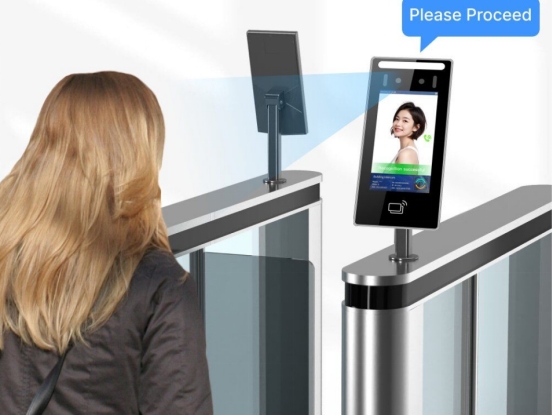
Face Recognition Database Capacity: More Than Facial Template Count
Enrolled Users and Temporary Credentials
A facial template database stores biometric templates used for 1:N face identification. The required facial template capacity should primarily account for enrolled employees, residents, contractors, service personnel, recurring users, and users authorized across multiple access points. Temporary visitors and alternative credentials should be evaluated separately according to the access-control workflow. An organization with 2,000 regular users may still prefer a 5,000-template terminal when staff turnover, temporary credentials, or expansion would otherwise provide insufficient capacity headroom.
Administrators should also decide whether each terminal stores the full user database or only the users authorized for that access point. A centralized access-control architecture can simplify user provisioning across multiple buildings, while access-point-specific authorization can limit unnecessary enrollment and synchronization at restricted entrances.
Facial Template Capacity vs. Record and Image Storage
Facial template capacity and record storage describe different resources. Facial template capacity determines how many users can be enrolled for face identification, while record capacity determines how many recognition, attendance, or door-access events can be retained on the device before records must be synchronized or cleared. Image retention requires additional storage compared with time-stamped event records without associated photographs.
How to Size a Face Recognition Terminal for Each Site
The 5,000-Face Tier
A 5,000-face capacity can be suitable for many offices, factories, dormitories, residential communities, and individual campus entrances, depending on enrollment volume and future expansion requirements. The WO501 combines this capacity with a 5-inch 480 × 854 IPS touchscreen, a binocular camera, liveness detection, 200,000 attendance records, and a recognition distance of 0.5–1.5 meters. It also supports up to 5,000 cards and an optional 5,000-palm-vein capacity, with multiple verification methods including face recognition, cards, QR codes, passwords, and optional palm-vein recognition.
Beyond attendance and access control, the WO501 integrates Smart Life video intercom functionality, supporting full-duplex audio and video communication, one-tap remote door release, and real-time video viewing through the mobile app. Network connectivity includes 10/100M Ethernet and 2.4 GHz Wi-Fi, with an optional 4G module, while Tuya Cloud integration supports access-event recording and review. Its IP54-rated enclosure and wall-mounted design make it suitable for a range of residential and commercial access-control applications.
The 20,000-Face Tier
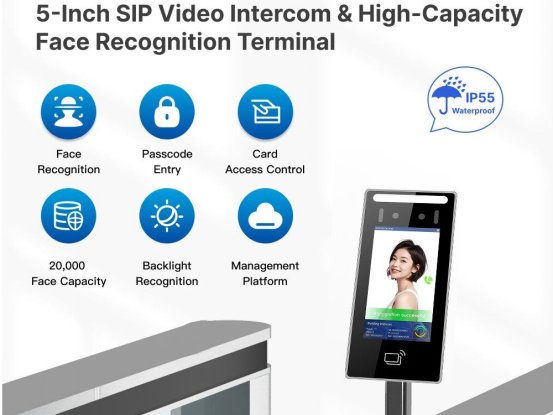
The WO523M is designed for sites that need a larger user base together with building communication. It supports 20,000 facial templates, 200,000 attendance records, a 5-inch 480 × 854 IPS touchscreen, and SIP-based one-to-one or one-to-many audio-video intercom. Face, QR code, mini-program, and IC/ID card methods allow the access policy to extend beyond facial identification.
Its dual-lens wide-dynamic camera and LED/infrared fill lights are designed to support face capture under changing lighting conditions, making the model suitable for apartment and commercial entrance applications. IP55 protection and wall mounting should be evaluated against the exact installation environment rather than treated as a universal outdoor specification.
The 50,000-to-100,000-Face Tier
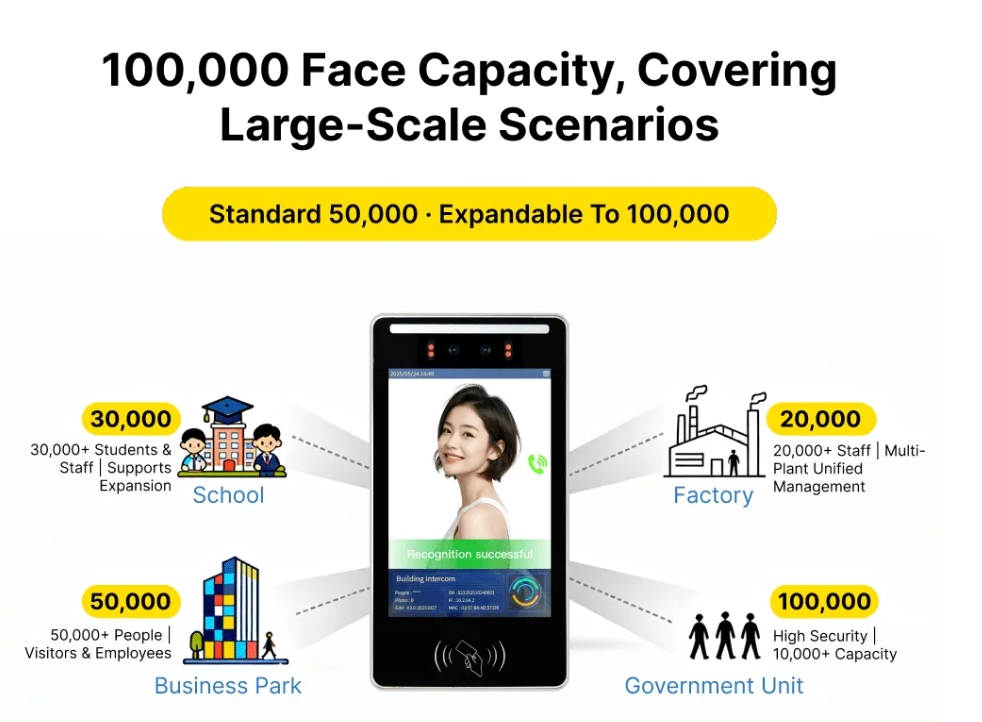
Large apartment communities, schools, and enterprise parks may need more headroom. The WO802 starts with 50,000 facial templates and is scalable to 100,000. Its 8-inch 800 × 1280 IPS touchscreen, SIP intercom, dual 2 MP wide-dynamic cameras, and IP65 rating support busy residential and commercial entrances.
Choosing this tier is justified when the database is genuinely large or expected to grow across a multi-building deployment. It should not be selected only because the capacity number is higher. Administrators must still plan enrollment quality, permission groups, network synchronization, and retention rules.
A Practical Face Capacity Calculation
A practical sizing model can start with the number of enrolled users who require facial identification, then add users who require access across multiple access points and a reasonable growth margin. Temporary visitors using QR codes, cards, or other credentials should be assessed separately because they may not consume facial template capacity.
Specifications That Keep Large Databases Practical
Processing, Recognition Distance, and User Flow
Uniwin-Global product specifications list recognition speeds of less than one second for the relevant models. Recognition distance, rather than recognition speed, is more directly related to the terminal’s approach zone. Actual peak throughput also depends on user behavior, authentication methods, door hardware, and network architecture.
Cameras, Fill Lights, and Liveness Detection
Binocular or dual-lens wide-dynamic cameras are designed to improve face capture under varying lighting conditions, while LED and infrared fill lights support low-light operation. Liveness detection is designed to mitigate presentation attacks involving photos, replayed videos, and 3D masks. These capabilities are particularly important at entrances with variable daylight.
Camera specifications should be assessed alongside mounting height, field of view (FOV), face pose, working distance, and the expected approach path. A higher face capacity cannot compensate for poor image capture. For projects with several doors, consistent camera positioning and enrollment procedures help reduce avoidable recognition problems.
Connectivity and SIP Intercom
Ethernet provides a stable foundation for fixed entrances, while Wi-Fi can simplify deployments where cabling is limited. Optional 4G connectivity can support deployments where wired network infrastructure is unavailable or impractical. For apartment or commercial reception workflows, SIP intercom adds one-to-one or group calling, allowing the terminal to combine user identification, visitor communication, and door-release workflows.
Matching Uniwin-Global Terminals to Applications
Workplace and Institutional Access Applications
For employee attendance, factory gates, campus doors, and dormitories, the Uniwin-Global face recognition terminal range provides compact 5-inch choices, such as WO501 Smart Life Video Intercom & 5-Inch AI Access Terminal.
Apartment and Commercial Access Control & Intercom
For a medium-sized building that needs SIP communication, WO523M combines a 20,000-face database with a compact 5-inch screen. For larger communities or enterprise sites, the WO802 high-capacity face recognition terminal adds 50,000-to-100,000-face scalability, an 8-inch screen, IP65 protection, and more authentication options.
Smart Locker Access
WR711 addresses a different workflow: intelligent locker access. Its 7-inch interface, 5,000-face database expandable to 20,000, and 200,000 records are paired with remote single-door or batch unlocking, multiple lockers per user, intermediate pickup, and configurable charging modes. It is therefore better evaluated by locker-management needs than by conventional entrance capacity alone.
Conclusion
The optimal face recognition terminal is not necessarily the model with the largest facial template capacity. It is the terminal whose face capacity, record storage, camera system, environmental protection, connectivity, and intercom functions match the site’s real operating conditions. Selecting excess database capacity without addressing workflow, integration, environmental, and maintenance requirements may result in an inefficient deployment.
Explore Uniwin-Global access control solutions to match terminal capacity, connectivity, and entrance workflows to your building.
FAQ
Q: Is a 5,000-face recognition terminal enough for an office?
A: It is sufficient for many small and medium-sized offices, provided the calculation includes enrolled employees, contractors, recurring users who require facial identification, and reasonable capacity for future growth. The organization should also verify record capacity and decide whether every terminal stores the full user list or only people authorized for a particular entrance.
Q: When should a building use a high-capacity face recognition terminal?
A: A high-capacity model is appropriate when the number of enrolled facial templates, multi-site users, or expected growth exceeds the practical limit of a smaller database tier. It is also useful when the site needs extensive record retention, SIP intercom, multiple authentication methods, and environmental protection. Capacity alone should not determine the selection.
Q: Can a face recognition terminal also support SIP video intercom?
A: Yes. Uniwin-Global models such as WO523M and WO802 combine facial identification with SIP-based audio-video intercom. They support one-to-one and one-to-many or group calls, enabling residents, visitors, or reception staff to communicate before remote door release. SIP support should be confirmed for the specific model.