A SIP video intercom for commercial buildings combines two-way audio and video communication with visitor access workflows. Depending on the system architecture, it can connect entrance stations with reception, security, or other authorized endpoints while working alongside access-control and door-management systems. The right design depends on entrance layout, reception procedures, user capacity, network architecture, and door-control integration. Uniwin-Global’s SIP-capable WO523M and WO802 provide two documented terminal formats for comparing compact and higher-capacity commercial access requirements.
SIP primarily provides the communication and call-signaling layer. Access authorization and door unlocking are normally handled through the access-control architecture, which may include a door controller, relay interface, locking hardware, credentials, and authorization rules. These functions should be evaluated as separate but integrated parts of the overall system.
Why Commercial Buildings Need a Video Intercom System
A Clearer Visitor Workflow
Audio-only intercom systems provide voice communication but limited visual context for visitor verification. Video verification improves situational awareness, but it does not replace access-control policies, credential validation, or security procedures.
Connecting Entrance Stations With Reception and Security
A commercial property may have a main lobby, loading entrance, staff door, parking access, or separate tenant areas. A SIP video intercom can support defined calling paths between an entrance terminal and approved endpoints, while the building team maintains control of permissions and release actions.
What a SIP Video Intercom Does
Visitor Calling and Two-Way Communication
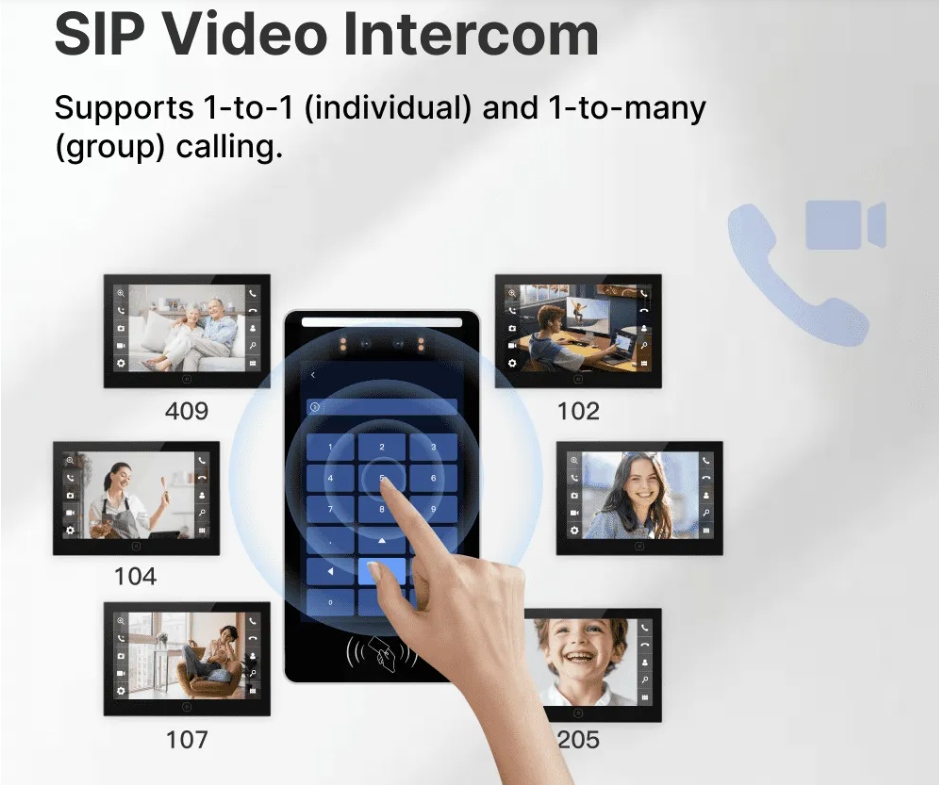
Applicable Uniwin-Global terminals support SIP video intercom functions. WO523M and WO802 document one-to-one calling, while WO802 also documents group calls. These functions can connect a visitor with reception, security, or authorized management station, but the SIP server, registrar, endpoint registration model, and call-routing architecture should be validated during system design and commissioning.
Authentication, Visitor Verification, and Door Release
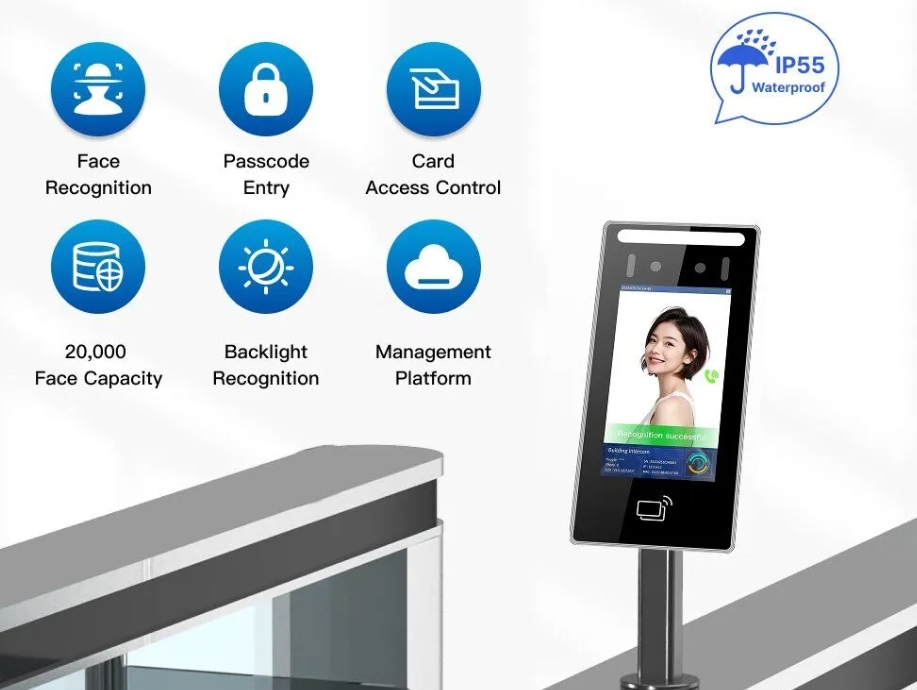
Video intercom may be combined with facial recognition or other authentication methods when the selected model supports them. WO523M and WO802 are documented as high-capacity face-recognition and SIP-intercom terminals. Remote door release should be integrated with the appropriate access control controller, relay interface, locking hardware, and authorization policy. The SIP endpoint provides the communication function and, where supported, may provide a door-release trigger. The access-control controller and associated locking hardware determine how authorization and door unlocking are executed.
Core Product Features to Evaluate
Display Size and Visitor Guidance
WO523M uses a 5-inch IPS display with 480 × 854 resolution. WO802 uses an 8-inch IPS display with 800 × 1280 resolution. A larger display can provide more screen area for visitor prompts, authentication instructions, and user interaction. Screen size alone does not determine recognition performance.
SIP Calling and Communication Modes
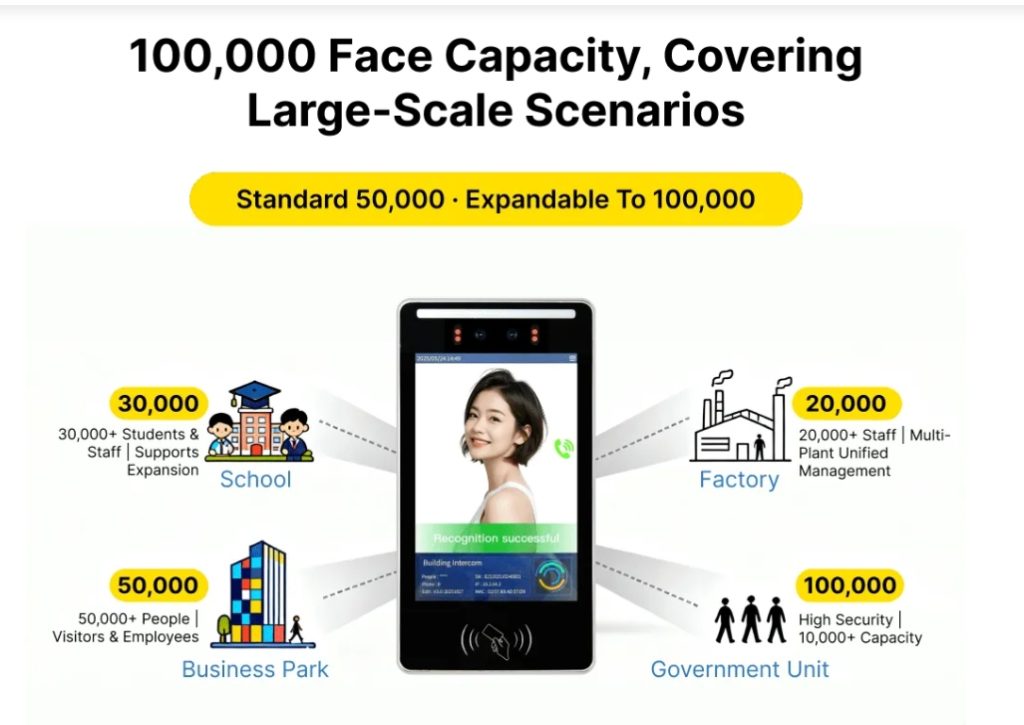
WO523M supports up to 20,000 face templates and 200,000 attendance records, with storage expandable to 1,000,000 records without images. WO802 supports 50,000 faces scalable to 100,000 and 200,000 attendance records expandable to 1,000,000 without images. Both models support SIP-based audio-visual intercom, including one-to-one and multi-endpoint calling.
Camera and Lighting Conditions
Selected terminal materials describe dual-lens or binocular cameras, wide dynamic range, and LED or infrared fill light. These features can help maintain image quality under variable illumination and backlighting conditions, but installation still needs attention to glare, subject positioning, mounting height, camera angle, and background illumination. No universal recognition speed or accuracy should be inferred.
Commercial Applications
Office Entrances and Reception Areas
An office may use a SIP video intercom at the main entrance so reception staff can identify visitors and route calls to an authorized response point. User roles should distinguish reception, security, tenants, and building management. The system should also define how calls are handled outside normal business hours.
Business Parks and Mixed-Use Properties
A business park or mixed-use property may have separate entrances for tenants, visitors, deliveries, and services. A terminal with higher face capacity or group calling may be considered when the site has several user groups, but the decision should follow documented population, entrance, and communication requirements.
Staff-Only Entrances and Restricted Areas
Commercial buildings often separate visitor entry from staff access. Facial authentication, cards, or other methods may be suitable depending on the selected model. The access-control design should define the credential lifecycle, including enrollment, authorization, expiration, revocation, replacement, and audit logging.
Planning SIP and Door-Control Integration
Server, Network, and Account Questions
Before installation, confirm the SIP server arrangement, account structure, endpoint registration, network segmentation, and maintenance responsibilities.
Remote Release and Controller Compatibility
A video call does not automatically define how a door opens. Confirm the relay, controller, power supply, emergency release, and authorization logic for each entrance. The installer should map the call path and release path separately so a communication issue does not create uncertainty about emergency operation.
Camera Placement and Lighting
Position the camera to capture the visitor’s face within the intended field of view and subject distance. Mounting height, camera angle, approach path, glare, and backlighting should be validated during commissioning.
Installation and Administration Considerations
Visitor Procedures and Enrollment
Define and document visitor-management procedures before commissioning. Define who answers calls, which users or roles are authorized to initiate remote door release, how face templates are enrolled, and how temporary or former users are removed. The procedure should also explain what happens when visitor authentication fails or when the network is unavailable.
Event Retention and Maintenance
WO523M and WO802 list attendance-record capacities, but the project should decide which access and intercom events are retained, who may review them, and how records are managed. Maintenance planning should include cleaning, software updates, cable checks, equipment replacement procedures, and an alternative process for a failed terminal.
Expansion for Additional Entrances
Plan spare capacity around real growth rather than an unsupported assumption of unlimited expansion. Additional entrances may require more endpoints, accounts, network planning, and controller coordination. A documented architecture makes later changes easier to assess.
Uniwin-Global SIP and Access Control Solutions
Uniwin-Global develops SIP intercom devices, face-recognition access terminals, embedded motherboards, and OEM/ODM hardware solutions. For commercial projects, the product selection can therefore be evaluated together with the required communication, access-control, and embedded-system architecture.
Conclusion
A SIP video intercom for commercial buildings should be evaluated as part of the complete access-control and communication architecture rather than as a standalone door-entry device. Key considerations include SIP server and endpoint compatibility, visitor workflows, authentication methods, door-controller integration, locking hardware, network design, environmental conditions, event management, and future expansion.
Contact Uniwin-Global to discuss your commercial SIP video intercom project and find a solution matched to your technical and operational requirements.
FAQ
Q: What is a SIP video intercom for commercial buildings?
A: A SIP video intercom is an IP-based communication endpoint that uses the Session Initiation Protocol (SIP) to establish audio and video communication between an entrance station and authorized endpoints such as reception desks, security stations, or management terminals. In a commercial access-control deployment, the intercom may be integrated with authentication devices, access-control controllers, door locks, and event-management systems.
Q: What is the difference between WO523M and WO802?
A: WO523M has a 5-inch IPS display, 20,000-face capacity, 200,000 attendance records, and documented one-to-one and one-to-many SIP calling. WO802 has an 8-inch display, 50,000 faces scalable to 100,000, expandable records, and documented one-to-one and group calls.
Q: Does SIP guarantee compatibility with every commercial access system?
A: No. SIP functions do not by themselves confirm compatibility with every server, codec, endpoint, door controller, relay, or management platform. The project should verify registration, account structure, network requirements, release hardware, and the specific communication workflow before deployment.
Q: How should a commercial building plan its intercom installation?
A: Map every entrance, visitor path, reception point, staff door, and release action. Then confirm display size, user capacity, calling mode, authentication, camera placement, lighting, SIP architecture, controller interfaces, event handling, maintenance, and future expansion. Model-specific documentation should guide every technical assumption.