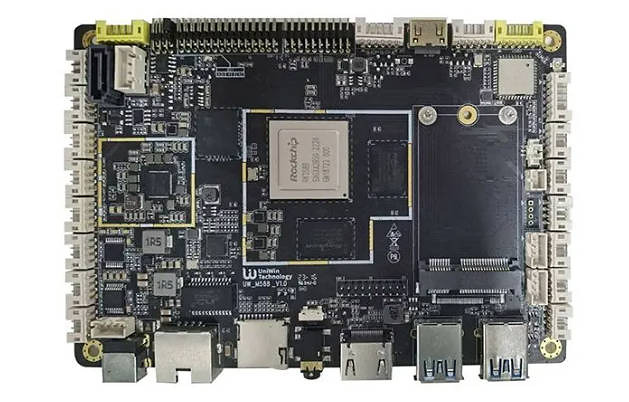
If you need a board for on-device AI that has plenty of scope for future development, the RK3588 M588 is the board to spec. With a 6 TOPS NPU, 4× Cortex-A76 + 4× Cortex-A55 CPU, Android 12 support and 9× USB, 7× serial, two eDP outputs and HDMI-IN, the RK3588 M588 is the highest-performance core in the embedded Android motherboards that Uniwin-Global offers for access control, attendance, SIP intercom and multi-display terminals. The following sections explain the significance of each specification for your project.
Why 6 TOPS of On-Device AI Compute Matters
Typical access control/intercom systems run on small CPUs which are OK for controlling and playing videos within menus. However, face recognition, liveness and person detection can benefit significantly from dedicated neural compute. The M588 is equipped with a 6 TOPS NPU which runs on the board itself and not on some remote server.
Frames can be processed locally where they were captured. So there is no need for a server and round trip communication when the application is configured for local inference, which keeps response time short and bandwidth usage on the terminal to a minimum. Also differences show up in terms of interface responsiveness when several cameras are connected to one unit.
This approach also allows the solution to stay local. Compared with architectures that shift the bulk of vision processing to the cloud and rely upon a stable connection, processing vision at the edge with an on-device NPU means that vision inference can be handled locally. This makes sense for a number of sites where a constant, stable connection to the cloud is not available or where data must stay within the site’s boundaries.
Processor, Display, and I/O Layout
CPU and AI Compute
The RK3588 pairs four Cortex-A76 cores with four Cortex-A55 cores, with main frequency up to 2.4 GHz. The A76 cores provide higher performance for demanding workloads, while the A55 cores are designed for more power-efficient workloads, with the operating system scheduling tasks according to load. The 6 TOPS NPU runs vision models in parallel with the CPU.
By separating face and liveness inference from other workloads that are continuously run throughout the day, the NPU can reduce CPU load and help keep the user interface responsive, while also leaving room for future features without having to rework the board.
Display, HDMI-IN, and Dual eDP
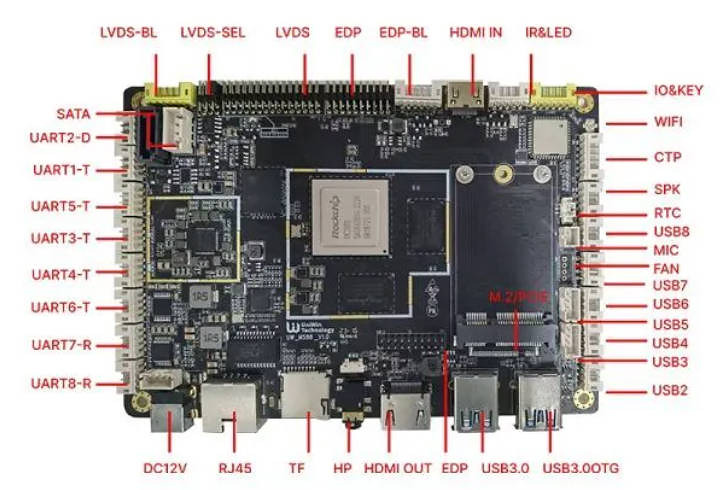
The M588 is a LVDS, MIPI, eDP and HDMI board. The board also supports HDMI-IN. In order to drive two displays from one board, the M588 is equipped with two eDP outputs, thus ideal for a main display plus a secondary display such as a camera-preview or status panel.
For those applications where the board is also acting as a display hub, HDMI-IN on the board is important. Some intercom and signage systems have video from external HDMI sources, and the board can bring in this video while driving displays through its supported output interfaces. This allows one board to be used with different front ends.
I/O, 9 USB and 7 Serial Ports
This board has 9 USB ports and 7 serial ports, including 5× TTL and 2× RS232. Two TTL ports can alternatively be configured as 2× RS232, 1× CAN, or 1× RS485. With Ethernet, WiFi and BT on board you can connect up cameras, readers, sensors and relays all without the need for a hub. A wide-dynamic face camera, a card reader and an output relay fit neatly on the board to keep the case small and parts list short.
| Item | Specification |
| CPU | RK3588, 4× Cortex-A76 + 4× Cortex-A55, up to 2.4 GHz |
| AI compute | 6 TOPS NPU |
| Operating system | Stable Android 12, with custom APIs |
| Display | LVDS, MIPI, eDP, HDMI, 2× eDP, HDMI-IN |
| I/O | 9 USB; 7 serial: 5× TTL + 2× RS232, with two TTL ports configurable as 2× RS232, 1× CAN, or 1× RS485; Ethernet, WiFi, BT |
| OS options | Android / Linux, additional options on request |
Android 12 and Custom Application APIs
The board is provided with a stable Android 12 system as well as a set of APIs tailored for our board. Thus, rather than having to write basic system calls from scratch, an application such as a face recognition, attendance system or even an intercom can be developed quickly on top of the provided hardware.
Uniwin-Global is a full range service provider in hardware, system, application and management-platform customization. Our boards can be delivered as finished devices and hence the integration work on your side can be minimized.
Where the RK3588 Android Motherboard Fits
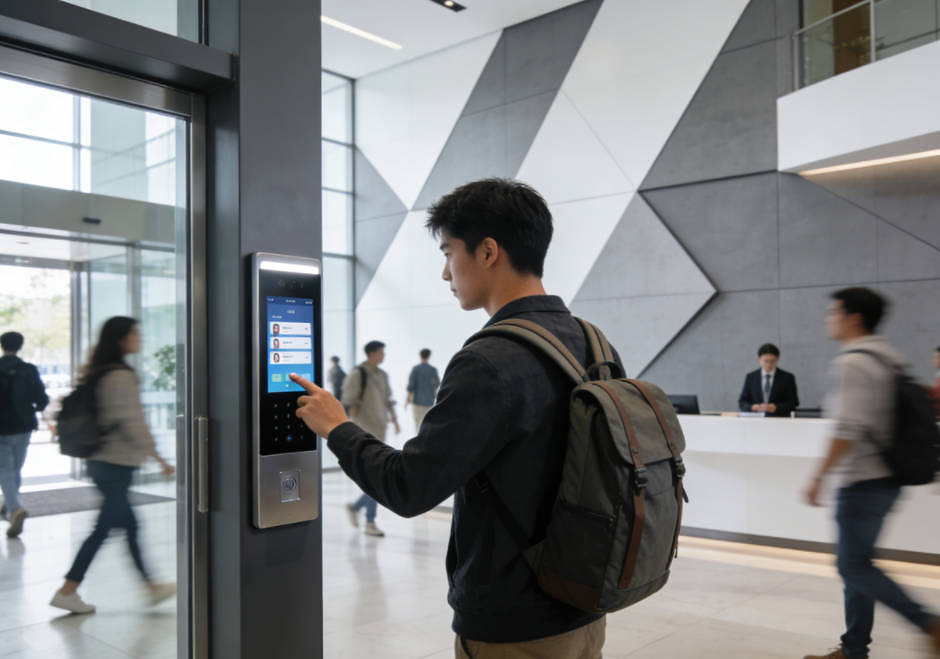
The M588 is aimed at terminals that need real vision processing. Face-recognition access control and attendance terminals are the natural fit, because the NPU can run the matching and liveness steps on board. SIP video intercom units that run person detection on the terminal benefit in the same way.
Multi-display kiosks are typically driven by the two eDP outputs from the single board. In designs that require an HDMI-IN connection for a camera feed or uplink, this port accepts video from the external source while the board drives the display through one of its supported output interfaces.
The platform supports a variety of Operating Systems including Android and Linux as well as additional OS options upon request. For those who are comparing the M588 to lower core count Rockchip alternatives within the same product line, refer to the RK3588 M588 spec sheet to review display, serial and USB port count to ensure that the part will meet design requirements.
How to Specify the M588 for Your Project
Treat the M588 as the compute and I/O core and size the rest of the enclosure around it. Match the display ports to your panel types, confirm how many serial devices need RS485 versus RS232, and decide whether HDMI-IN is part of your signal path.
The 9 USB ports on this board offer extra connectivity for items like cameras and readers. Be sure to check the mechanical envelope and connector placement for this board versus your housing before you finalize a design, as those can end up being big issues.
Place the M588 up against lower core count parts and weigh 6 TOPS of NPU compute to the price delta. If you need on-device AI and don’t have a server to run against, this margin is what justifies the platform.
Conclusion
RK3588 M588 board provides edge-AI real terminal headroom, Android 12 stable base and required I/O to make a complete device. It can cover all compute, display and connectivity required for access control, intercom and multi-display applications on a single board.
We highly recommend specifying an RK3588 Android motherboard with 6 TOPS on-device AI power early in your design phase. For the M588 review, sample availability and customization discussion are available at Contact Uniwin-Global. Customer issues can receive a response within 2 hours, and the board is covered by a 1-year warranty with less than 1% defect rate.
FAQ
Q: What is the AI compute capability of the RK3588 M588?
M588 uses RK3588 with a 6 TOPS NPU, allowing face recognition and liveness detection to be executed on the board instead of on a server when the application is configured for local inference. The board is designed for terminals constantly performing vision-related tasks, thus the detection can be fast even when the network is slow.
Q: Which operating systems does the RK3588 M588 support?
It ships with a stable Android 12 system. The RK3588 platform also supports Linux and other operating-system options on request, so the same board can serve more than one product line. That is useful when one hardware platform has to cover both Android and Linux devices.
Q: Can the RK3588 M588 drive more than one display?
Yes. This single-board computer features two eDP outputs for 2 screens as well as LVDS, MIPI and HDMI. It even features an HDMI-IN connection, so the board can accept external video while controlling screens at the same time. That should be sufficient for almost all single- or dual-display terminal setups.
Q: How much customization does Uniwin-Global offer for the M588?
Uniwin-Global offers customization for hardware, system, application and management-platform. SKD, OEM and ODM projects are also provided. A ready-to-use board can be delivered as a finished terminal, as a bare motherboard that can be completed by customer or as a starting point for customer’s finished product.