The right industrial motherboard for AI access control depends on the complete terminal workload. Designers should match CPU and NPU capability, camera interfaces, memory, storage, operating system, communication ports, and upgrade requirements to the product being built. A compact attendance terminal has different needs from a high-capacity SIP intercom or multimedia gate controller.
Uniwin-Global develops motherboard platforms for AI access control, smart terminals, attendance, and intercom applications. Reviewing the hardware by function helps integrators build a stable product without selecting performance or interfaces that the finished device cannot use.
Why the Motherboard Determines AI Access Performance
Processing Facial Data at the Edge
Facial access control can require face detection, tracking, liveness detection, template matching, camera-image processing, and local event handling. The CPU manages system services while an NPU can accelerate supported AI workloads. If the processor is underspecified, recognition and user-interface tasks compete for resources; if it is oversized, the added capability may not improve a single-door terminal.
Matching Board Capability to Terminal Function
A board should be selected around the product workflow. An attendance terminal may prioritize efficient face verification, card readers, and local records. A residential intercom may need SIP audio-video, relay and Wiegand connections, while a complex smart terminal may require several displays, cameras, USB devices, and a stronger multimedia processor.
Core Specifications to Compare
CPU and NPU Processing
The EEASYTECH SV830 platform is documented for dynamic face recognition, up to 5,000 face records, multiple unlocking methods, relay and Wiegand input/output, and HTTP, WebSocket, and MQTT protocols. The EEASYTECH SV826 platform is documented with up to 1.5 TOPS NPU performance for AI access-control processing. These examples show why NPU capability should be tied to the target algorithm and camera workload rather than treated as a standalone ranking.
Camera and Display Interfaces
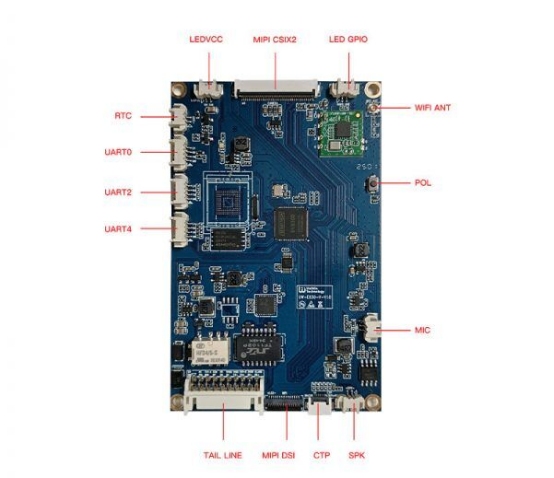
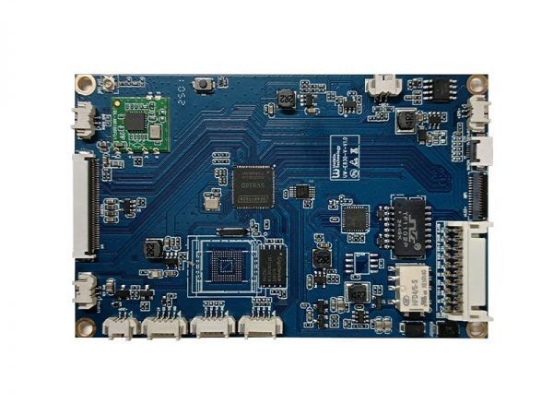
Camera and display compatibility must be checked before mechanical design. Access terminals may use MIPI camera interfaces, while displays can require LVDS, MIPI, eDP, or HDMI. Uniwin-Global platform materials document combinations of these interfaces on selected boards, allowing integrators to match camera modules, touchscreens, and enclosure dimensions to the intended terminal.
Memory and Storage Planning
Memory affects operating-system stability, application behavior, and simultaneous services. Storage is used for system software, face templates, attendance events, configuration, and update packages. The correct DDR and eMMC configuration depends on the application; a board intended for a simple access terminal should not be presented as equivalent to a high-performance multimedia platform.
I/O and Industrial Communication
Access-control hardware frequently requires more than a network socket. USB can connect peripherals, while serial interfaces may support RS232 or RS485 devices. Relay and Wiegand signals connect door hardware and readers. HTTP, MQTT, and WebSocket support can connect a terminal to management software, while SIP support is relevant to video-intercom products. Every protocol and port should be verified on the selected model.
Matching Uniwin-Global Platforms to Applications
Attendance and Compact Access Terminals
SV830 is a practical reference for compact face-recognition attendance and access-control products. Its documented functions include face recognition, card, password, and fingerprint unlocking, support for up to 5,000 face records, remote mini-program door opening, relay and Wiegand interfaces, and standard network protocols. This combination suits a product where biometric verification and peripheral integration are central.
SIP Intercom and Residential Access
SV823 is documented for SIP and private-protocol video intercom applications, making it relevant to building access and connected door-entry products. The final design should confirm the supported camera, display, audio, relay, and network interfaces before the board is assigned to an apartment station or similar device.
Operating System and Integration Flexibility
Android and Linux Deployment
Uniwin-Global materials document both Android and Linux platforms across its motherboard range. The operating system should be selected according to application software, update strategy, peripheral drivers, and the integrator’s development environment. Android can suit rich touch interfaces and application ecosystems, while Linux may fit focused embedded products; the exact supported version remains model-specific.
OEM and ODM Product Development
Uniwin-Global’s documented customization scope includes hardware, system, application, management platform, and mini-program development. This can help product teams align the motherboard, enclosure, user interface, door-control logic, and management workflow. Customization requirements should be written as an interface and software specification rather than left as a general performance request.
Practical Selection Checklist
Define the AI Workload
Clarify whether the terminal needs face detection, liveness detection, attendance, intercom, visitor handling, local records, or several functions at the same time. This definition determines the useful CPU, NPU, memory, storage, and camera requirements.
Confirm Interfaces Before Mechanical Design
List the camera, display, touchscreen, reader, relay, Wiegand, serial, USB, audio, and network interfaces before finalizing the PCB and enclosure.
Plan for Product Growth
Leave reasonable room for application updates, additional peripherals, database growth, and future product variants. However, expansion should be based on the documented platform and project plan, not an unsupported assumption that every board can scale indefinitely.
Conclusion
An industrial motherboard is the computing and integration foundation of an AI access-control product. Uniwin-Global’s SV830, SV823, SV826, and RK3588/M588 platforms address different combinations of biometric processing, camera and display interfaces, communication protocols, operating systems, and peripheral expansion. Choosing the board around the terminal’s actual workload creates a more reliable and maintainable product.
Contact Uniwin-Global to discuss your project requirements and explore a suitable motherboard or OEM/ODM solution for your next-generation smart security terminal.
FAQ
Q: What is an industrial motherboard for AI access control?
A: It is an embedded computing board designed to run the processing, interfaces, operating system, and peripheral connections required by an access-control terminal. Depending on the platform, it may support camera input, NPU acceleration, local records, relay or Wiegand control, networking, intercom, and application software.
Q: Which interfaces matter when designing an AI access-control terminal?
A: Camera and display interfaces are fundamental, but integrators should also check USB, serial ports, RS232, RS485, relay, Wiegand, audio, Ethernet, Wi-Fi, and optional cellular connectivity. The correct list depends on the reader, door controller, touchscreen, intercom, and management system used by the finished product.
Q: Can Uniwin-Global customize an industrial motherboard solution?
A: Uniwin-Global documents customization across hardware, system, application, management platform, and mini-program development. The project team should provide a written specification covering AI workload, cameras, displays, peripherals, protocols, enclosure, operating system, and update requirements so the selected platform can be evaluated accurately.