As more apartments and residential complexes go online, conventional analog intercoms tend to fall short in delivering convenient and secure access control. SIP intercom systems, which employ VoIP technology and IP networks, provide a smarter, more scalable option. They integrate audio and video communication with remote monitoring, smartphone support, and advanced security features—the perfect solution for homes, offices, and public spaces.

Understanding SIP Intercom Systems
What Is a SIP Intercom?
SIP intercom is a next-generation communication system that utilizes Session Initiation Protocol (SIP) to allow audio and video communications over IP networks. SIP intercom systems are different from traditional analog intercoms in that they are digital and support advanced features such as remote access, compatibility with smart devices, and real-time monitoring. SIP intercom systems are applied extensively in residential apartments, office buildings, and public spaces where secure, efficient access control is required.
How SIP Implements VoIP Technology
SIP is the signaling technology for VoIP that enables devices to set up, manage, and end voice or video calls via IP networks. This makes SIP intercoms operational in a comparable manner to VoIP phones, with added functionality of opening doors and integration with CCTV (Closed Circuit Television) systems. The use of IP networks makes remote management possible and inclusion in cloud platforms for centralized management.
Key Components of SIP Intercom System
A typical SIP intercom system includes:
- Outdoor Stations: Equipped with cameras, microphones, and sometimes biometric scanners for identifying visitors.
- Indoor Monitors or Terminals: Receive calls, display video, and offer door control.
- Central Server or Cloud Platform: Regulates communications, access privileges, and records.
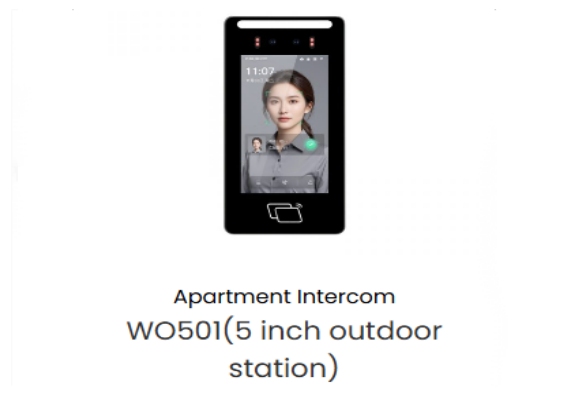
For example, Uniwin-Global’s 5-inch WO501 outdoor station supports audio-video intercom, one-to-one/group calls, face recognition, liveness detection, identity verification, and real-time visitor record. Indoor displays like the WI704 7-inch model provide a split-screen display and PoE installation, supporting the ease of deployment in smart offices or apartments.
How SIP Intercom Works
Communication Over IP Networks
SIP intercoms share information through standard IP protocols on LAN or WAN networks. This ensures smooth information transfer from one unit to another, wherever the units are. For example, residents are summoned by visitors even when they are away from home via mobile apps connected to the internet.
Integration with Current Access Systems
New SIP intercom solutions are designed to integrate seamlessly with installed access control infrastructure. Device-side integration protocols, such as MQTT/HTTP/WEBSOCKET, enable third-party cloud connection support. Compatibility is confirmed through the support of connection to various security ecosystems, like biometric readers and RFID scanners.
Real-Time Audio and Video Transmission
With wide dynamic high-definition cameras implemented in external stations like the WO501, customers experience live audio-visual communication. It supports challenging conditions like heavy light and poor light, and has characteristics of fast recognition speed, precision, and a huge library storage capacity. It offers a crystal clear vision despite challenging lighting.
Advantages Over Traditional Analog Intercoms
Improved Audio and Video Quality
Legacy analog systems are more susceptible to signal degradation. SIP-based systems, however, offer crystal-clear audio and HD video due to digital carriage over IP networks.
Scalability and Flexibility
New unit installation or coverage expansion in analog systems can be wasteful. SIP-based intercom-based intelligent apartment or community access control systems, however, can be expanded at a whim by merely adding more devices to the network.
Easier Installation and Maintenance
Because they employ standard networking equipment such as Ethernet switches or PoE injectors, SIP intercoms reduce the use of dedicated cables. Equipments such as our WI704 (7-inch indoor monitor with split-screen) have support for POE power supply, and installation is simplified.
Easy Integration with Smart Devices
SIP intercoms work according to plan using mobile phones via apps or mini-programs. Mini-program function remote door opening is part of the features provided by our E518-V motherboard model utilized in integrated terminal solutions.

Why Modern Access Control Needs SIP Technology
Growing Demand for Smart Security
With increasingly complex cities, there is a greater demand for simple yet secure systems. SIP technology enables features like facial recognition-based access control, which are at the heart of security today.
Network-Based Management
Network communication enables central management of multiple entrances in many buildings or locations. Network communication also enables features like cloud-based visitor registers—key to enterprise-level security compliance requirements.
Future-Proof Security
With a SIP-based platform, long-term future-proofing becomes inevitable with future technologies like AI-based analytics or IoT-readiness. Uniwin-Global’s M588 motherboard featuring RK3588 (Cortex-A76x4+Cortex-A55 x4) 6-core processor provides next-gen AI security software processing needs.
Uniwin-Global’s Approach towards SIP Intercom Innovation
Smart Features
At Uniwin-Global, we focus first on delivering intelligent features in all products that we manufacture. Our WR501 attendance terminal supports face recognition, identity verification, and liveness detection, so it is preferable to deploy both in attendance tracking and secure entry management.
Compatibility with Modern Building Management Systems
Our products support multiple standard docking protocols like HTTP/websocket/MQTT—making it simple to integrate them into building management systems as they are. For a shopping mall or business complex office, we have our own set of compatibility solutions fitting just the bill.
Custom Solutions
From compact solutions such as the WOZ01 mini outdoor station for villas to high-performance multi-purpose terminals like WI704, we have customized installations fitting the specific requirements of your environment.
Choosing the Right SIP Intercom System
Things to Remember
When upgrading, take note of:
- Number of entry points.
- Features required (e.g., facial recognition).
- Integration requirements.
- Budget requirements.
- Uniwin-Global provides solutions scalable to cater to basic needs and top-end enterprise requirements.
Model Recommendations per Application
- Residential Complexes: WO501 outdoor stations for intensive visitor management.
- Indoor Surveillance: WI704 monitors for multi-channel safety surveillance.
- Construction Sites or Enterprise Attendance: WR501 terminals supporting LAN/WAN platform.
Support and Services
Uniwin-Global provides professional technical services:
- 2-hour reply, 48-hour settlement.
- Start-to-finish service from consultancy to post-sales support.
- OEM/ODM customization to fit project-specific requirements.
FAQ
Q: Do Uniwin-Global SIP intercoms support integration with my existing smart home system?
A: Absolutely! Solutions utilize common protocols like MQTT/HTTP/WEBSOCKET, which are easy to plug into smart home apps.
Q: What is the difference between the villa intercom WI704 and the apartment intercom WO501?
A: WO501 is an outdoor station utilized for face recognition & guest interaction; WI704 is an indoor monitor having multi-channel preview & alarm function suitable for single-family homes.
Q: Is customization service available at Uniwin-Global?
A: Yes! We provide OEM/ODM partnership as well as SKD cooperation models, which are designed specifically per project requirements.
Q: Why is your hardware reliable?
A: All the material is ensured to be original and packaged. With a less than 1% defect rate, the motherboard warranty period is 1 year.